Cross-border operations3 min read
A five-minute runbook for live translation failure
Classify viewer impact, isolate the failed layer, choose a safe fallback, and verify recovery from a viewer device without derailing the main broadcast.
Practical guidance for teams streaming to overseas audiences: platform differences, language pairs, time zones and script localisation.
Once the technical stack works, operations decide the outcome. This topic covers everything that is not the pipeline.
More language pairs is not better. Running Chinese to English, Indonesian and Vietnamese at once sounds like wider reach. In practice, every audience segment concludes that the stream is not really for them. The cost of multilingual streaming is not compute — it is that your script, your product selection and your interaction can only be designed around one audience.
The time zone decides whether you are working nights. Southeast Asia is within an hour of China; Europe is six to eight hours out and North America twelve to fifteen, and both shift by an hour when daylight saving changes. This is not a scheduling problem, it is a sustainability problem. A lot of cross-border programmes die in week three because someone built a rota no human can keep.
Scripts cannot be translated literally. The Chinese live-selling staples — addressing the audience as family, “link is up”, the three-two-one countdown — mean nothing when translated word for word. What you need is functional equivalence in the target culture, not lexical equivalence.
Douyin, Kuaishou, TikTok and WeChat Channels differ in comment protocols, eligibility requirements and cross-border compliance. The same technical setup can be trivial on one and awkward on another. We cover them individually rather than claiming blanket support for “all major platforms”.
Matching products to languages, choosing broadcast windows, keeping comment interaction natural despite translation latency, and the compliance considerations specific to selling across borders.
Technology solves “can they understand you”. It does not solve “do they want to listen”.
Classify viewer impact, isolate the failed layer, choose a safe fallback, and verify recovery from a viewer device without derailing the main broadcast.
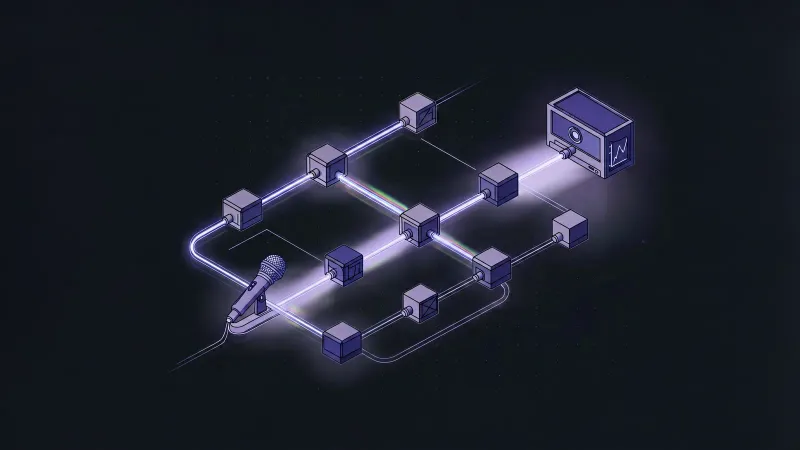
Rehearse audio, recognition, translation, playback, captions, OBS, and the real viewer device with observable evidence before every broadcast.

Four kinds of Chinese live selling phrasing that break somewhere in the translation pipeline, why each one breaks, and what to say instead.

Why simultaneous multilingual streaming usually fails, how machine translation quality varies by pair, and what time zones do to rotas.

What your platform exposes decides the whole design. Filter on official event types first, catch repeat questions with triggers, translate the rest.